
Butterfly weed (Asclepias tuberosa) is an obligate larval host plant for the monarch butterfly. Photo: Wikimedia Commons / CC.
Generalist vs. Specialist Pollinator Plants
Not all native plants are equally valuable to all pollinators. The distinction between generalist and specialist relationships shapes how useful a given plant is to native bees in particular.
Generalist plants — such as goldenrods, coneflowers, and asters — are visited by a wide range of insects for nectar and pollen. They provide broad-spectrum support and form the backbone of most native habitat plantings.
Specialist plants support a narrower set of bee genera that can only collect pollen from that specific plant family. These oligolectic bees have evolved mouthparts, body hair structure, or behavioral timing precisely matched to their host plant. Without the plant, the bee cannot complete its reproductive cycle. In Canada, specialists include bees in the genera Andrena, Colletes, Melissodes, and Perdita, among others.
Milkweeds and the Monarch
The relationship between milkweeds (Asclepias spp.) and the monarch butterfly (Danaus plexippus) is among the most documented host plant relationships in North America. Monarch larvae can only develop on milkweed; they sequester cardenolide compounds from the leaves that provide chemical protection against predators throughout their life cycle.
In Canada, the most relevant milkweed species are:
- Common Milkweed (Asclepias syriaca): The most widespread species in eastern Canada. Thrives in full sun in disturbed soils, roadsides, and meadow edges. Spreads aggressively by rhizome — suitable for larger naturalized areas rather than formal garden beds.
- Butterfly Weed (Asclepias tuberosa): More compact and ornamental. Deep orange flower clusters from June to August. Requires well-drained, dry to medium soil. Hardy to zone 4 in Canada.
- Swamp Milkweed (Asclepias incarnata): Suited to moist areas, rain gardens, and streamside plantings. Pink flower clusters July–August. Tolerates wet conditions where other milkweeds fail.
Beyond monarchs, milkweeds support a range of specialist and generalist bees, as well as several moth species, milkweed beetles, and aphids that support predatory insect populations.
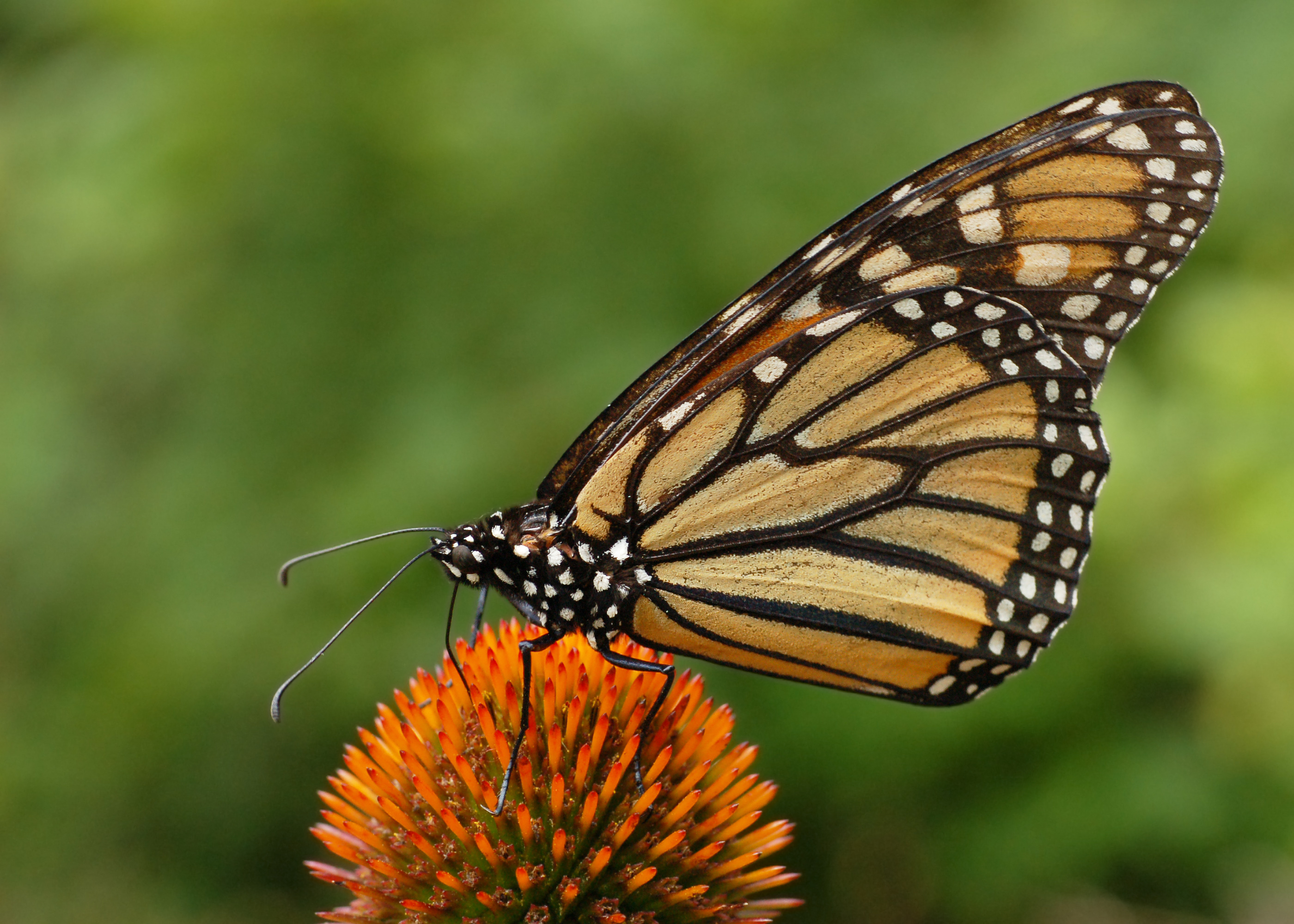
Monarch butterfly (Danaus plexippus) nectaring on purple coneflower. Milkweed is required for larval development; coneflowers support adults during migration. Photo: Wikimedia Commons / CC.
Swallowtail Host Relationships
Canada hosts several swallowtail butterfly species with specific larval host plant associations:
Canadian Tiger Swallowtail (Papilio canadensis)
One of Canada's most recognizable butterflies, present from coast to coast. Larvae feed on a range of woody plants including wild cherry (Prunus spp.), trembling aspen (Populus tremuloides), birches (Betula spp.), and willows (Salix spp.). Adults nectar on lilacs, thistles, and native wildflowers.
Black Swallowtail (Papilio polyxenes)
Present in southern Canada from British Columbia to Nova Scotia. Larvae are host-specific to the carrot family (Apiaceae), including wild carrot, Queen Anne's lace, and native species such as golden alexanders (Zizia aurea) and prairie parsley. Golden alexanders is particularly well-suited to garden planting as a dual-purpose native: it blooms yellow in May–June, supports specialist bees of the genus Andrena, and serves as a primary swallowtail larval host.
Giant Swallowtail (Papilio cresphontes)
Found in southern Ontario and Quebec. Larval hosts are members of the rue family (Rutaceae), particularly northern prickly ash (Zanthoxylum americanum), which is native to Ontario and Quebec. Adults are strong nectarers on milkweeds and native composites.
Specialist Native Bees and Their Host Plants
The following plant genera support known oligolectic (specialist) bees present in Canada:
| Plant Genus | Example Native Species | Specialist Bee Genera Supported |
|---|---|---|
| Solidago (goldenrods) | Canada goldenrod, stiff goldenrod | Andrena, Colletes, Melissodes |
| Symphyotrichum (asters) | New England aster, smooth aster | Andrena (aster-specialist spp.) |
| Helianthus (sunflowers) | Prairie sunflower, woodland sunflower | Melissodes, Diadasia |
| Monarda (bergamots) | Wild bergamot, scarlet bee balm | Anthophora, specialized bumble bees |
| Zizia (golden alexanders) | Zizia aurea | Andrena (carrot-family specialists) |
| Lobelia (lobelias) | Cardinal flower, great blue lobelia | Long-tongued bumble bees |
Bumble Bees and Preferred Forage
Canada hosts 41 bumble bee species, some of which have experienced severe range contractions in recent decades. Habitat loss and pathogen exposure are among the documented contributing factors. Several species — including the western bumble bee (Bombus occidentalis) and yellow-banded bumble bee (Bombus terricola) — are now listed as Species at Risk in Canada.
Bumble bees are generalists in their pollen use but have physical preferences. Their longer tongues allow access to tubular flowers — bergamot, cardinal flower, native clovers — that shorter-tongued bees cannot exploit. Including at least one tubular-flowered native per bloom season ensures bumble bees have accessible forage throughout the growing period.
Queen bumble bees emerge in early spring and require early-blooming pollen sources within a short flight range of their overwintering sites (typically underground, in rodent burrow cavities or under thick leaf litter). A yard with bloodroot, wild columbine, and willows blooming in April–May is directly supporting queen establishment, which determines whether a colony forms at all that season.
Nesting Materials: An Overlooked Host Function
Host plant relationships extend beyond food. Several native bee genera use plant materials for nest construction:
- Leafcutter bees (Megachile spp.): Cut circular portions from leaves of roses, lilacs, and some native shrubs to construct cell partitions in their stem or wood-cavity nests.
- Wool carder bees (Anthidium spp.): Collect plant fibers — particularly from lamb's ear, though native downy plants also serve — to line nest cells.
- Mason bees (Osmia spp.): Do not collect plant nesting material but require clay-rich soil or existing cavities adjacent to their floral host plants.
Maintaining a section of bare, undisturbed soil in a sunny area of the yard supports ground-nesting bees, which represent over 70% of Canada's native bee species by count.
References
- Canada Species at Risk Public Registry
- Xerces Society — Pollinator Plants
- Monarch Watch — Milkweed Information
- Ontario Nature — Bumble Bee Watch
Last updated: May 2026